Reasons to keep The Crook Inn
N.B. We welcome any additional ideas for this list. Please email them to savepub@savethecrook.org.uk
Social cohesion: the Crook Inn has been a family friendly, welcoming place to meet for locals, newcomers and visitors. This has resulted in a vibrant and confident community.
Employment: there are few opportunities outside of agriculture in the area.
Tourism: other businesses in the surrounding area rely on hotels like the Crook to bring tourists into the area not just pass through to look at the scenery.
Post office: up to May 2006 the Crook provided post office services.
A focal point for the community where you always knew there would be someone to point the visitor in the right direction or accept a parcel from a lost delivery driver.
A haven at times of challenge for the community.
One of the key aspects of maintaining a strong sense of community is to have a friendly meeting place. The Crook Inn has provided this venue for the past 400 years.
These events have become increasingly difficult to hold at The Crook Inn since it was sold 7 months ago. If the plans for housing go ahead, it will be impossible and 400 years of continuity within the community will come to an end.
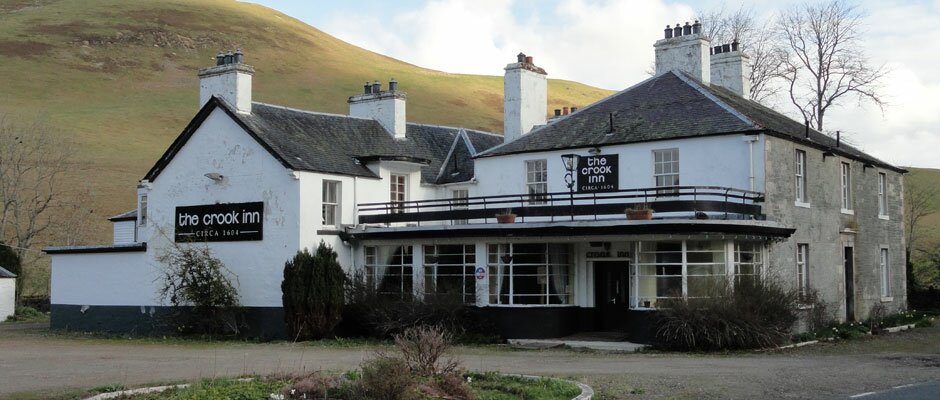
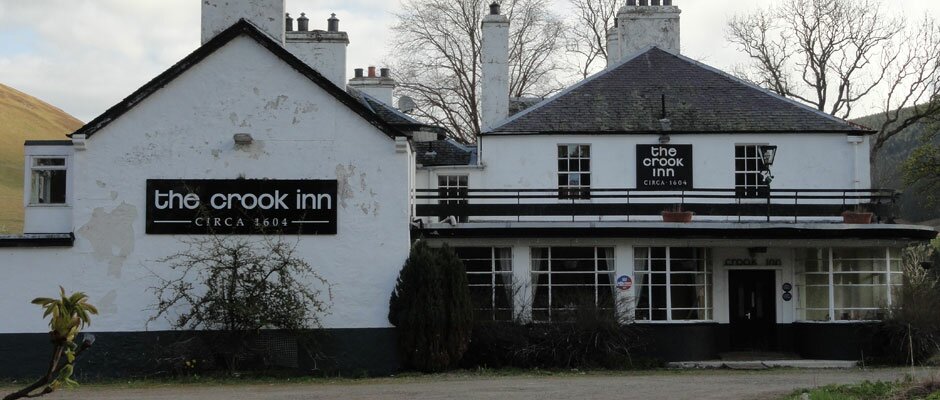
Listed Building & Historical Significance
Grade C(S) listed building
described as early 19th century incorporating earlier fabric. latre additions
and interior remodelling.
The Crook Inn's own website
states it's importance locally and nationally as the oldest licenced Coaching
Inn in Scotland. It states the bar is early 17th century retaining many of it's
original features such as the flagstone floor.
The bar may be the remains of a peel tower.
Was a farm and inn
Shown on Timothy Pont’s map of 1590
1603 Union of the Crowns resulted in change in ideas on licensing
1604 Three coaching inns were licensed: Crook Inn Tweedsmuir
Spreadeagle Jedburgh
Kings house
1863 Rebuilt after a fire and marked at reopening by a meeting of the gentlemen’s
dining club. Run by ‘Jeanie of the Crook’ and the occasion marked
by a write-up in the Scotsman.
1917 Sold by Tweedies
to Mastertons
1936 Art Deco changes by James Taylor of Glasgow
The following list are points where we believe the proposed plans go against the planning policies defined in the Scottish Borders Local Plan.